Your starting path

Understand why signals appear

Understand what made the signal appear.

Read a marked setup the way the engine read it: which conditions passed, which blocked it, and how comparable setups resolved before.

4 chapters Chart · Signal · Inspect · Compare

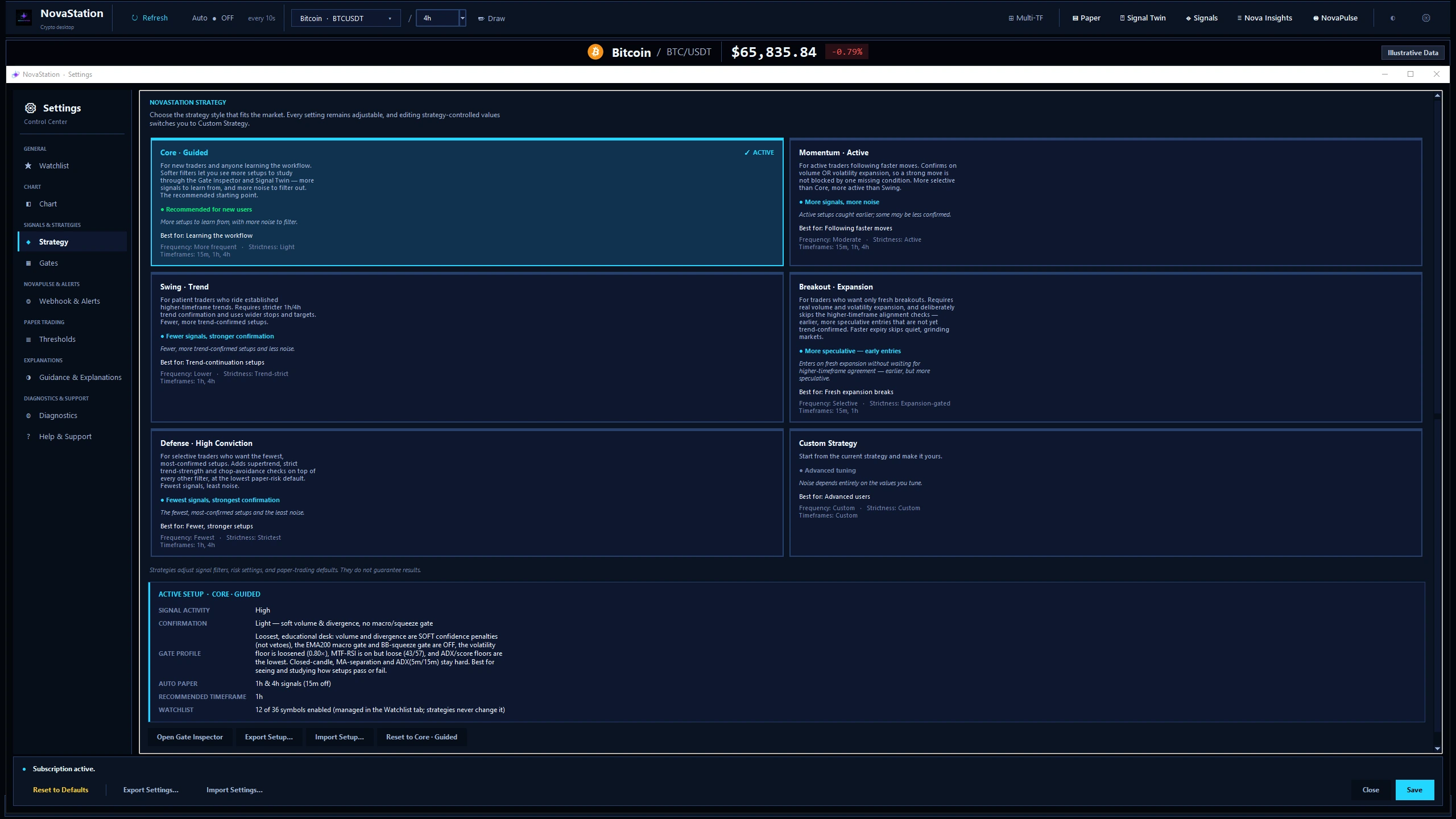
The NovaStation Strategy settings screen in dark mode: six preset cards — Core — Guided (active), Momentum — Active, Swing — Trend, Breakout — Expansion, Defense — High Conviction and Custom Strategy — each describing who it is for and its tradeoff in signal frequency, strictness and timeframes, above a summary of the active setup and a note that strategies do not guarantee results.
The Strategy screen and its six presets, with Core — Guided active. Each preset states who it suits and what it trades off; none of them guarantees a result.

Begin path

Where this path fits

  • ChartIn this path
  • SignalIn this path
  • InspectIn this path
  • CompareIn this path
  • MonitorLater, in the app
  • PracticeLater, in the app
  • ReviewLater, in the app

Highlighted stages are the ones this path walks.

Understand why signals appear

Chart

Chapter 1 of 4 · 0 of 4 read · 0%

  1. Chart Current chapter
  2. Signal Not read yet
  3. Inspect Not read yet
  4. Compare Not read yet
Next: Signal

Change path

The path

4 chapters, in the order the loop runs.

Chapter 1 of 4 Chart

Start with what the market was doing.

NovaStation opens on the chart, with nothing marked on it yet — the same candles the strategy is about to judge.

What to look for

The status bar under the chart — the last closed candle, the timeframe regime, and the engine's current read before any marker exists.

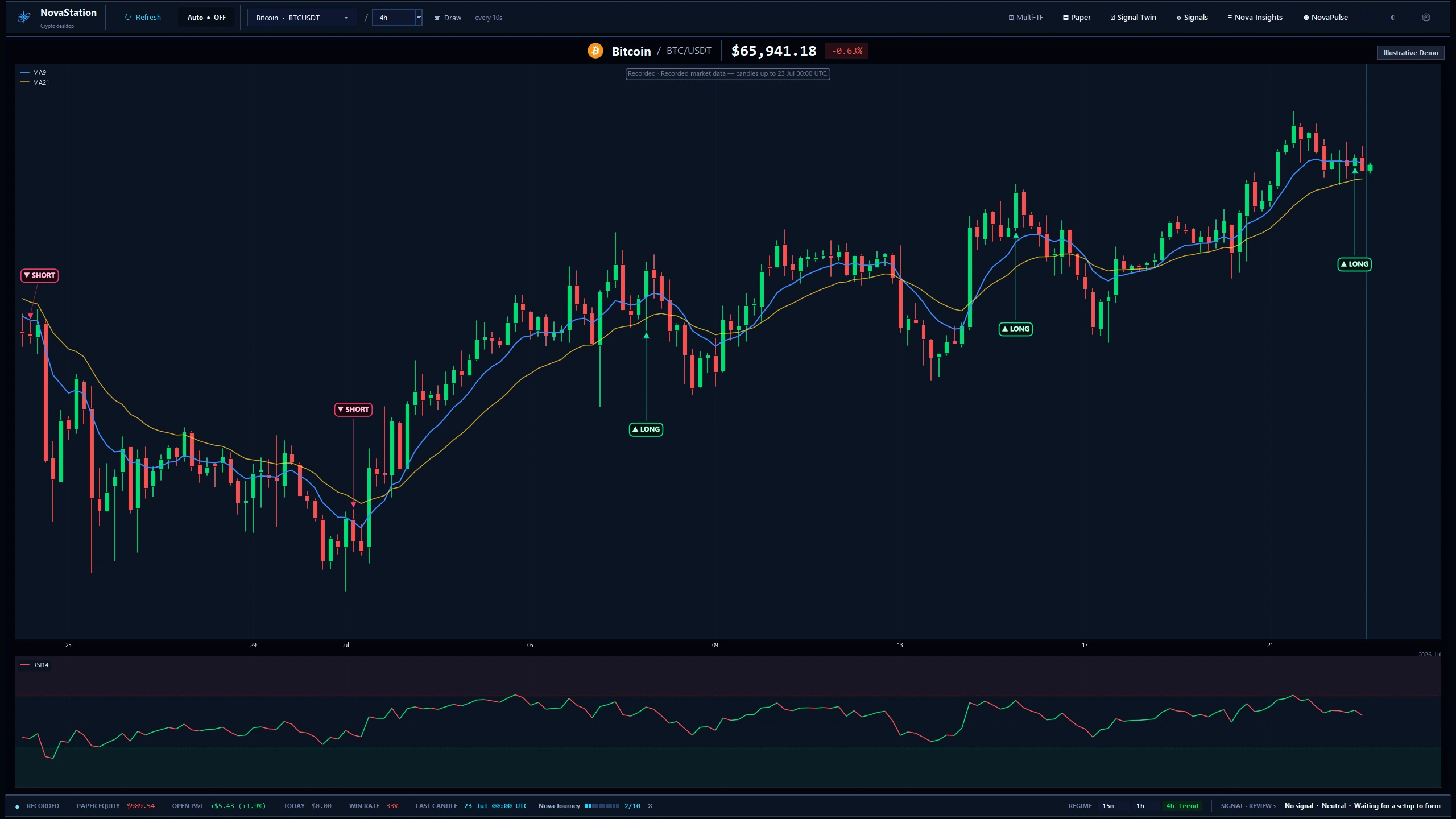
The NovaStation workstation on a recorded BTC/USDT 4h chart: MA9 and MA21 over the candles, sparse LONG and SHORT setup markers, an RSI panel underneath, and a status bar showing the last recorded candle, the timeframe regime and the engine's current no-signal review. The app labels the frame Recorded and Illustrative Demo.
The main workstation on a recorded BTC/USDT 4h chart. The frame is labelled Recorded and Illustrative Demo — this is a captured session, not live data.

Context comes first. The marker is an answer to a question the chart already asked.

Continue to Signal

Chapter 2 of 4 Signal

See where the setup formed.

The engine evaluates each closed candle and marks the ones where its conditions came together. The next two stages are the evidence behind it.

What to look for

The verdict line for the evaluated candle, and the plain-language note saying what the engine is still waiting for.

A signal is a claim with a timestamp, not an instruction to act.

Continue to Inspect

Chapter 3 of 4 Inspect

Read the conditions behind the claim.

The setup carries its own read: the main reason it formed, the main blocker holding it back, and every condition behind both.

What to look for

The main blocker. What a strategy refuses to trade tells you more about it than what it accepts.

If you cannot see why a setup appeared, you are taking it on trust.

Continue to Compare

Chapter 4 of 4 Compare

Check it against setups that formed the same way.

Signal Twin finds setups that formed under similar conditions, so the current one is read against something rather than in isolation.

What to look for

The sample size and the confidence flag before the headline percentage. A small sample is a caveat, not a result.

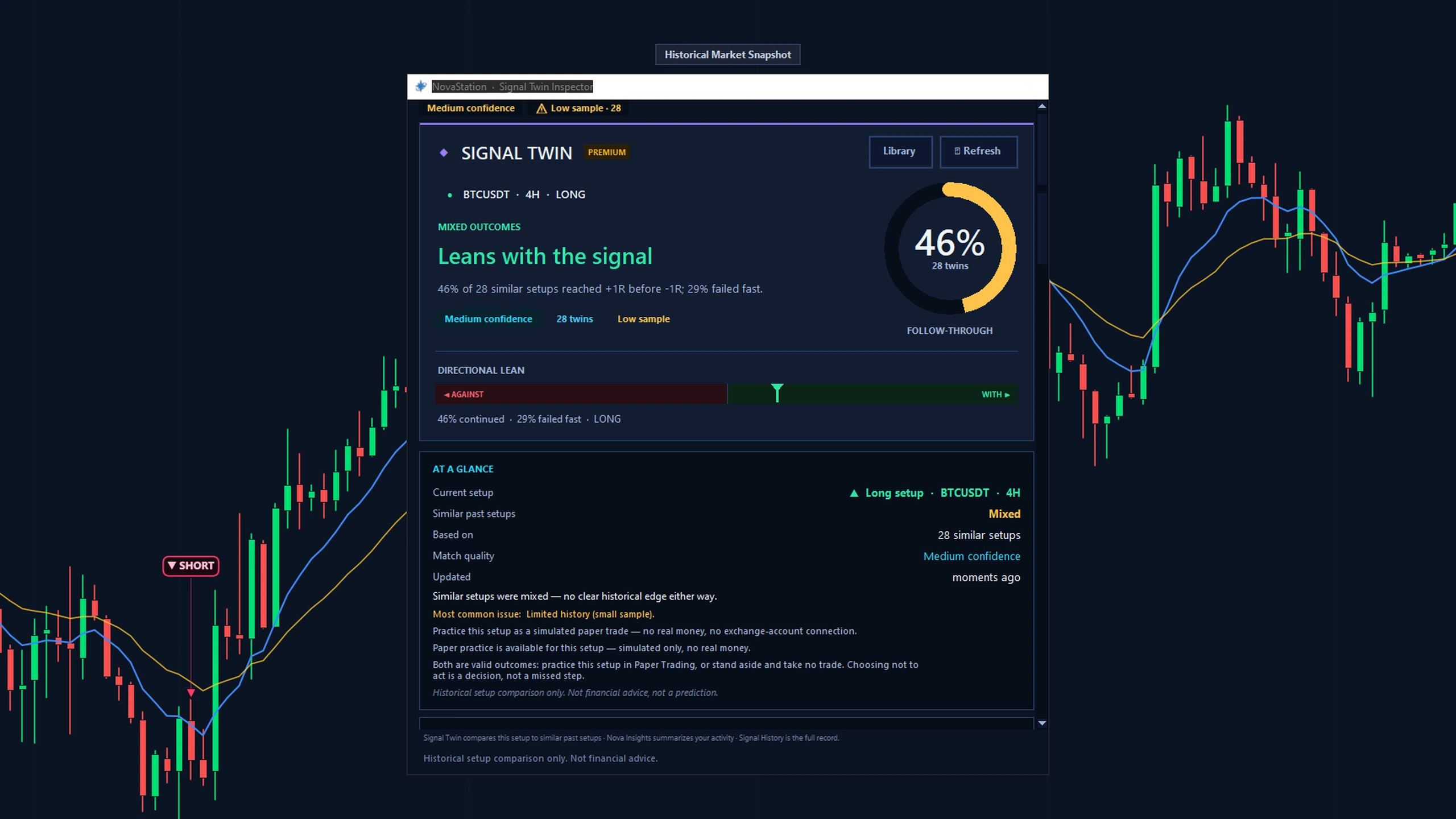
NovaStation's Signal Twin Inspector over a recorded BTC/USDT 4h market snapshot: a LONG setup compared against 28 similar past setups, with a 46% follow-through dial, a directional-lean bar and an at-a-glance summary reading “mixed — no clear historical edge either way”. The window flags medium confidence and a low sample, and states that it is historical setup comparison only, not financial advice and not a prediction.
Signal Twin on a recorded snapshot: one LONG setup against 28 comparable past ones. The window flags the low sample and reads “mixed — no clear historical edge”.

Historical context, not a prediction.

Complete this path

First move

Do this first.

Open one marked setup and identify what passed, waited, and blocked.

Access

What this path costs.

Lite Chart

Trial or Premium Signal · Inspect · Compare

Trial 7 days · starts inside the app · no card

Chart is the free Lite workspace — for as long as you like, with no account and no card. The other stages are Premium: you start the trial from inside the desktop app, not from this website, and it does not ask for a card. See pricing for what Premium costs afterwards.

  • A signal is context, not an instruction. NovaStation marks what it read; the decision stays yours.
  • Historical comparisons describe what already happened. They are not predictions.
Next

Continue in NovaStation

You read a marked setup the way the engine reads it: the chart it formed on, the conditions it scored, and the comparable setups behind it.
Download NovaStation Download for Windows View Windows Download View Windows Download Details Read the Quick Start

Lite is free and needs no account. NovaStation requires Windows 10 or 11.

Inside the app, Nova Journey can walk you to the reasoning behind a setup — optional, and dismissible whenever you like.

Starting somewhere else? Change starting path